
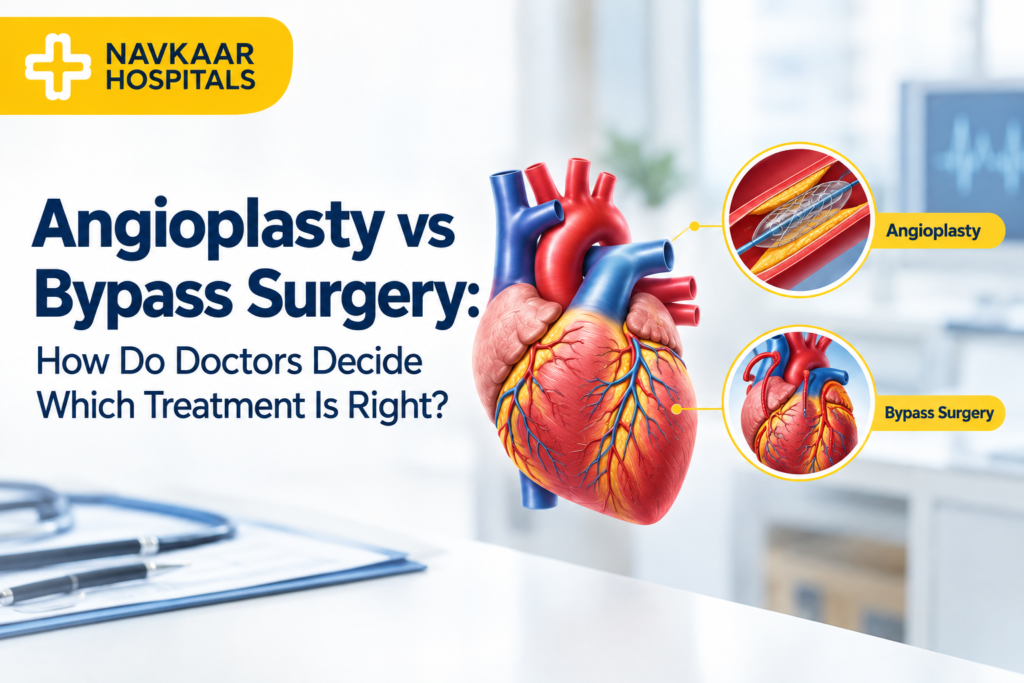
Finding out that you have a blocked artery in your heart brings up one urgent question. Do you need a stent, or do you need open heart surgery? Patients often search for a simple rule that tells them which treatment fits their case, but heart disease does not work that way. Two people with the same number of blockages can end up with two completely different treatment plans, and both plans can be correct.
This article explains how a cardiologist in Mumbai actually thinks through the decision between angioplasty vs bypass surgery, what factors matter most, and what you can expect once a treatment is chosen.
What Is Coronary Angioplasty?
Coronary angioplasty is a procedure used to open a narrowed or blocked artery in the heart. A cardiologist inserts a thin tube called a catheter through a blood vessel in the wrist or groin and guides it to the blocked area. A small balloon is inflated to push the blockage outward, and a metal mesh tube called a stent is usually left behind to keep the artery open.
This is often called angioplasty for heart blockage, and it is done through a small puncture rather than an open incision using an advanced Cath Lab setup. Most patients are awake during the procedure and go home within a day or two.
What Is Bypass Surgery (CABG)?
Coronary bypass surgery, medically known as coronary artery bypass grafting or CABG, takes a different approach. Instead of opening the blocked artery, the cardiac surgeon in Mumbai creates an entirely new route for blood to flow around the blockage. A healthy blood vessel is taken from another part of the body, usually the chest wall, arm, or leg, and connected above and below the blocked segment.
Bypass surgery for heart blockage is an open heart operation performed under general anesthesia, though many centers, including advanced cardio thoracic and vascular surgery units, now also offer keyhole bypass surgery, a less invasive alternative to the traditional open chest approach.
The Main Difference Between Angioplasty and Bypass Surgery
The core difference between angioplasty and bypass surgery comes down to how each one solves the same problem. Angioplasty clears or props open the existing artery from the inside. Bypass surgery builds a new pathway around the blocked section entirely.
Angioplasty is less invasive and has a quicker recovery. Bypass surgery involves a bigger operation but can treat more extensive or complicated blockages in one procedure. Neither approach is superior in every situation, which is exactly why this decision needs individual assessment rather than a fixed rule.
When Is Angioplasty Recommended?
When is angioplasty recommended depends on where the blockage is, how severe it is, and how the artery is shaped. Angioplasty is often considered for:
- A single blocked artery, sometimes called single vessel disease treatment
- Blockages that are shorter in length and easier to reach with a catheter
- Patients who are having a heart attack and need the artery opened quickly
- Patients who may not be strong enough to tolerate open heart surgery
- Situations where a stent can achieve a similar result to surgery with lower short-term risk
When Is Bypass Surgery Needed?
When is bypass surgery needed usually relates to how widespread and complex the disease is. Surgeons and cardiologists tend to lean toward bypass when:
- Several arteries are blocked at once, particularly in three vessel disease treatment
- The blockage is in the left main coronary artery, which supplies a large portion of the heart muscle
- The blockages are long, heavily calcified, or located at difficult branching points
- The patient has diabetes along with multiple blocked arteries
- The heart’s pumping function is already reduced
Why the Number of Blockages Alone Does Not Decide Treatment
A common misunderstanding is that having two or three blocked arteries automatically means bypass surgery is required. That is not accurate. Multiple heart blockages treatment depends far more on where those blockages sit and how complicated they are than on the raw count.
Someone with three short, straightforward blockages in accessible locations may still be a reasonable candidate for angioplasty. Someone with a single blockage in a difficult spot, such as at the origin of the left main artery, may need surgery even though only one artery is involved. This is why doctors look at the whole picture rather than counting blockages like items on a checklist.
Why Blockage Location and Complexity Matter
Cardiologists often use a scoring system that rates how complex the coronary artery disease is, factoring in things like how twisted the artery is, whether there is heavy calcium buildup, whether the blockage sits at a branch point, and how long the narrowed segment is.
A short, soft blockage in a straight part of the artery is technically easier to treat with a stent. A long, hardened blockage wrapped around a branching point is much harder to fix with angioplasty and may respond better to a surgical bypass. This is a major reason two patients with a similar number of blockages can receive completely different recommendations.
How Diabetes and Other Health Conditions Affect the Decision
Diabetes changes how coronary artery disease behaves. It tends to affect multiple arteries at once and can make the disease more diffuse rather than confined to one clear spot. Because of this, patients with diabetes and multiple blocked arteries are often steered toward bypass surgery, since studies over the years have generally shown better long-term outcomes for this specific group.
Kidney disease also plays a role. Angioplasty involves a contrast dye that can put stress on the kidneys, while bypass surgery carries its own risks for patients with reduced kidney function. Other conditions such as prior stroke, lung disease, or peripheral artery disease are also weighed carefully, since they can shift the balance toward the option with a lower overall risk for that particular patient.
How Doctors Assess Heart Function and Surgical Risk
Before recommending either option, the cardiology team typically evaluates the heart’s pumping strength using an echocardiogram or similar test. A heart that is already weakened may tolerate one type of procedure better than another.
Doctors also calculate a surgical risk score based on age, overall health, prior surgeries, and other medical conditions. A patient who has already had bypass surgery in the past, or a previous heart procedure, may need a different approach the second time around, since scar tissue and prior grafts can make repeat surgery more complex.
Age by itself does not rule anything out. What matters more is a person’s overall fitness, frailty, and ability to recover, which is why two patients of the same age can be handled very differently.
Emergency Situations Such as a Heart Attack
When someone is having a heart attack, time becomes the most urgent factor. In this setting, angioplasty vs bypass is rarely a long deliberation. Angioplasty is usually the faster option and can restore blood flow within minutes of reaching the artery, which is why it is the standard emergency approach in most heart attack cases, supported by round the clock emergency cardiac care.
Bypass surgery is generally reserved for heart attack patients when the coronary anatomy is not suitable for a stent, or when angioplasty is not immediately available. If you experience sudden chest pain, pressure, breathlessness, sweating, or pain spreading to the arm or jaw, seek emergency medical attention immediately rather than waiting to see if the symptoms pass.
When Medicines and Lifestyle Changes Come First
Not every blockage needs an immediate procedure. Some patients with stable, mild symptoms and blockages that are not severely limiting blood flow are managed with medications, blood pressure and cholesterol control, diabetes management, and lifestyle changes such as diet, exercise, and quitting smoking.
This approach, sometimes called optimal medical therapy, is often tried first in less urgent cases, with coronary artery disease treatment escalated to angioplasty or bypass only if symptoms persist or tests show the blockage is genuinely limiting blood flow to the heart muscle.
How Doctors Compare the Benefits and Risks
When cardiologists and surgeons sit down to compare CABG vs angioplasty, sometimes framed by patients simply as stent vs bypass surgery, for a specific patient, they are essentially weighing short-term risk against long-term durability, and simplicity against completeness.
Angioplasty typically means a shorter procedure, less pain, and a faster return to daily life, but a stented artery can sometimes re-narrow over time, and separate blockages that come up later may need their own treatment. Bypass surgery involves a longer recovery and a bigger initial risk from the operation itself, but a well-placed bypass graft, particularly one using an artery from the chest wall, can remain open for many years and treats multiple diseased areas in a single operation.
Complex cases, especially those involving three vessel disease or left main artery blockage combined with other health conditions, are often reviewed by a Heart Team. This is a multidisciplinary discussion between an interventional cardiologist in Mumbai and cardiac surgeons who look at the imaging together and agree on the safest and most effective path forward.
Angioplasty vs Bypass Surgery Recovery
Angioplasty vs bypass surgery recovery looks quite different in the first few weeks.
After angioplasty, most patients go home within one to two days. Walking and light activity can usually resume within a few days, though your cardiologist will guide you on when to return to work and driving. Blood thinning medication is prescribed for a period of time to protect the stent, and skipping doses without medical advice can be risky.
After bypass surgery, hospital stays typically run five to seven days, followed by several weeks of gradual recovery at home. Walking is encouraged early, but full recovery, including returning to normal activity and work, generally takes six to eight weeks. Cardiac rehabilitation, a supervised program of exercise and education, is commonly recommended after bypass surgery and is also useful after angioplasty.
Why Success Rates Cannot Be Reduced to One Number
Patients often ask about angioplasty vs bypass surgery success rate as if there is a single percentage that applies to everyone. There isn’t. Outcomes depend heavily on the patient’s underlying heart function, the extent and complexity of the disease, other health conditions, and how well the chosen treatment matches that specific anatomy.
The same applies to angioplasty vs bypass surgery risks. Both procedures carry real risks, including bleeding, infection, irregular heart rhythm, and in rare cases more serious complications, and both can also go very smoothly depending on the individual. A number that describes a large study population does not necessarily describe what will happen for you, which is why your own test results and medical history matter more than general statistics.
So Which Is Better, Angioplasty or Bypass Surgery?
There is no universal answer to which is better angioplasty or bypass surgery, and any source that claims one option is best for everyone is oversimplifying a genuinely individual decision.
The right choice depends on where your blockages are, how many arteries are involved, how complex the disease is, whether you have diabetes, kidney disease, or reduced heart function, your age and general fitness, your surgical risk, whether you have had previous procedures, and your own preferences about recovery time and long-term goals. In practice, how do doctors decide between angioplasty and bypass comes down to matching the treatment to the anatomy and the person, not applying a fixed formula. Framed simply as bypass surgery vs angioplasty or angioplasty or bypass surgery, the answer is always specific to the patient in front of the doctor.
Questions to Ask Your Cardiologist
Before agreeing to either angioplasty or bypass surgery, it can help to ask your cardiologist:
- Where exactly are my blockages, and how severe is each one?
- Is my disease considered simple or complex based on imaging?
- Would a Heart Team discussion be useful in my case?
- What are the specific risks of each option for someone with my health history?
- What would recovery look like for me personally?
- Are there medication or lifestyle-based options I should try first?
- What happens if this treatment does not fully resolve my symptoms?
Bringing a written list of questions to your appointment often leads to a clearer, more confident conversation.
Finding the Right Care Team
If you are searching for a cardiologist in Mumbai or comparing a heart hospital in Mumbai, it helps to look beyond just the availability of a single procedure. A hospital that offers both angioplasty treatment in Mumbai and serves as a bypass surgery hospital in Mumbai allows your cardiologist and cardiac surgeon to review your case together, rather than referring you elsewhere if surgery turns out to be the more appropriate option.
Look for a center with experienced interventional cardiologists and cardiac surgeons, modern diagnostic facilities such as angiography and echocardiography, a well-equipped Cath Lab, round the clock emergency cardiac care, and a track record of handling both straightforward and complex cases. Navkaar Hospitals in Bhandup, Mumbai, offers this combined setup through its cardiology department and cardio thoracic and vascular surgery unit, supported by a modern Cath Lab and 24/7 critical care. A team that can offer a complete treatment plan, from diagnosis through recovery, generally makes the decision-making process smoother for patients and families. You can view the full list of heart specialists in Mumbai or book an appointment to discuss your reports with a cardiologist.
When to Seek Urgent Medical Attention
Do not wait to schedule a routine appointment if you experience chest pain or pressure that does not go away, breathlessness at rest, cold sweats with chest discomfort, pain spreading to the jaw, neck, back, or arm, or sudden dizziness with any of these symptoms. These can indicate an evolving heart attack, and getting to an emergency department quickly can make a meaningful difference to the outcome.
A Final Word
Heart blockage treatment is not a contest between two procedures with one automatic winner. Angioplasty and bypass surgery serve different purposes, suit different types of blockages, and fit different patients. The best path forward is the one that matches your specific coronary anatomy, your overall health, and your personal circumstances, decided together with a cardiologist who has reviewed your complete picture.
If you or a family member have been told you need treatment for a heart blockage, take the time to understand your specific case, ask questions, and seek a second opinion if you feel uncertain. An informed decision, made with your cardiology team, is far more valuable than a general answer found online.