You wake up with a stiff neck. By afternoon it has not eased, and by evening a dull ache has crept into your shoulder. Maybe your fingers tingle when you work at the laptop, or your head hurts after a long commute. Most people put it down to a bad pillow or a tough week and carry on.
For many, though, the cause is cervical spondylosis, the gradual wear and tear of the neck’s discs and joints. It is extremely common and sits behind a large share of chronic neck pain in adults. Most people over 60 show some of these changes on imaging, and many have mild symptoms or none at all.
This guide explains what the condition is, what symptoms to watch for, why arm pain and tingling happen, how doctors confirm the diagnosis, and which treatments work without surgery. It also covers when an operation becomes necessary and which neck exercises are generally safe to discuss with your doctor. If you are looking for cervical spondylosis treatment in Mumbai, you will also find what to expect at a first consultation, and the warning signs that should never be ignored.
In short:
- Cervical spondylosis is age-related wear of the neck; it is common and often painless.
- Most people improve with physiotherapy, medication and lifestyle changes, which is cervical spondylosis treatment without surgery.
- Clumsy hands, unsteady walking, or loss of bladder or bowel control need prompt medical attention.
- Cervical spondylosis exercises help most when they are matched to your examination findings, not copied from the internet.
What Is Cervical Spondylosis?
Cervical spondylosis is age-related wear and tear of the discs and joints in the neck. Over time, discs lose water and shrink, the small joints develop arthritis, and bony growths called bone spurs may form. Many people have these changes without symptoms; when symptoms appear, neck pain and stiffness are the most common.
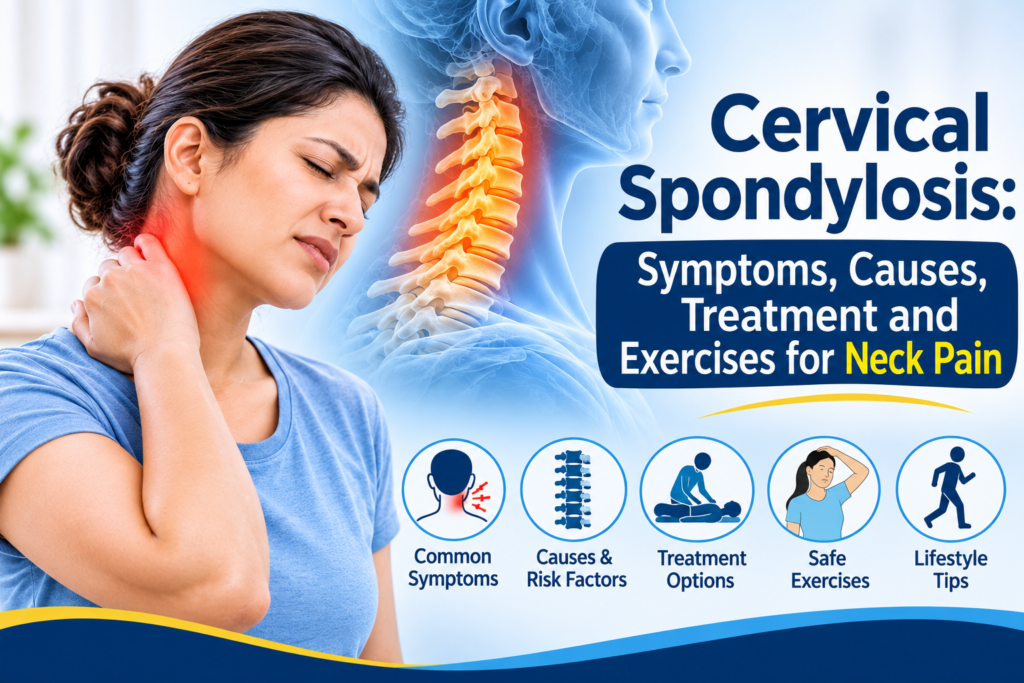
Your neck (the cervical spine) is made of seven small vertebrae stacked from the base of the skull downwards. Soft discs sit between them like cushions, and paired facet joints at the back let your head nod and turn. Through the middle of this column runs the spinal cord, and nerve roots leave through small openings on each side to supply your shoulders, arms and hands.
As discs thin out, the vertebrae carry more load and the body responds by growing extra bone along the edges. These changes can narrow the space for the nerve roots or the spinal cord. That narrowing, not the wear itself, is what causes the more troublesome symptoms.
You may hear the same condition called cervical osteoarthritis, cervical disc degeneration or arthritis of the neck. Two similar-sounding terms are different conditions:
- Spondylosis is degenerative wear (this article).
- Spondylitis is inflammatory arthritis of the spine, such as ankylosing spondylitis.
- Spondylolisthesis is forward slipping of one vertebra over another.
Many middle-aged and older people have worn discs that never cause pain. So an X-ray or MRI report that says “spondylosis” does not by itself mean something serious is wrong.
What Are the Symptoms of Cervical Spondylosis?
For most people, cervical spondylosis causes no symptoms. When it does, the typical cervical spondylosis symptoms are neck pain and stiffness, sometimes with headaches, shoulder pain, or tingling and numbness in the arms or hands. Weakness or clumsiness in the hands, or trouble walking, suggests nerve or spinal cord involvement and needs prompt assessment.
Neck pain and stiffness. This is the most common complaint. The pain can be mild or severe, and it often worsens with prolonged sitting, driving or looking down, and eases with movement or rest. Many people notice the neck is stiffest in the morning.
Shoulder pain. The ache often spreads across the top of the shoulders and between the shoulder blades, because the neck muscles and nerves share this region.
Headaches. Pain that starts at the back of the head or the base of the skull and travels upwards is common with neck problems.
Grinding or popping. A creaking sensation when you turn your neck is a possible symptom. It is usually harmless on its own.
Tingling and numbness. Pins-and-needles in the arm, hand or fingers suggest a nerve root is irritated.
Pain radiating towards the arms. A sharp or burning neck pain radiating to arm or fingers points to a pinched nerve (cervical radiculopathy).
Muscle weakness. Dropping things, a weaker grip, or difficulty lifting the arm can happen when a nerve is compressed for some time.
The table below shows how symptoms differ depending on what is being squeezed.
| What is affected | Typical symptoms | How urgent? |
| Neck joints and muscles | Neck pain, stiffness, headache, reduced movement | Routine; can often be managed without surgery |
| A nerve root (radiculopathy) | Pain, tingling or weakness in one arm or hand; often worse with certain neck positions | See a doctor soon if it persists beyond a few weeks or weakness appears |
| The spinal cord (myelopathy) | Clumsy or numb hands, difficulty with buttons or handwriting, unsteady walking, stiff or heavy legs, bladder or bowel changes | Needs prompt specialist assessment |
What Causes Cervical Spondylosis?
There is rarely a single cause. The cervical spondylosis causes build up over years from several overlapping factors:
- Age-related changes. Discs gradually dehydrate and flatten, and spinal ligaments stiffen, which makes the neck less flexible.
- Cervical disc degeneration. As discs lose height, the vertebrae move closer together and the facet joints take more strain. A disc may also bulge or herniate.
- Bone spurs. The body grows extra bone to stabilise the worn segment. Spurs are not painful by themselves, but they can crowd nearby nerves, and this wear of the neck joints is often called cervical osteoarthritis.
- Previous neck injuries. An old whiplash from a road accident or a fall can speed up wear in the injured segments.
- Occupational and lifestyle factors. Jobs involving repetitive neck movements, awkward positions or a lot of overhead work add stress to the neck.
- Prolonged poor posture. Posture alone is unlikely to be the only cause, but hours in a head-forward position at a desk or over a phone can aggravate a neck that already has degenerative changes.
Who Is at Risk of Developing Cervical Spondylosis?
Age is the strongest risk factor for cervical spondylosis. Beyond that, the following raise the risk:
- A family history of neck pain or spondylosis.
- Smoking, which is linked with more neck pain.
- Work that involves repetitive neck motion or overhead tasks.
- A previous neck injury.
- Ongoing stress, depression or anxiety, which are linked with more neck pain.
Staying physically active tends to help. People who walk daily are less likely to have neck and low back pain.
How Does Cervical Spondylosis Cause Arm Pain and Nerve Compression?
Cervical spondylosis can cause arm pain when bone spurs, a bulging disc or thickened joints narrow the small openings where nerve roots leave the spine. The pinched nerve sends pain, tingling or weakness along its path into the shoulder, arm or hand. This is cervical nerve compression, and when it affects a nerve root it is called cervical radiculopathy.
Each nerve root supplies a particular part of the arm and hand, which is why doctors can often work out which level is affected from where you feel the symptoms.
The encouraging news is that most people with cervical radiculopathy improve over time and do not need surgery. For some the pain settles in days or weeks; for others it takes longer. It can also return later, and usually settles again. This is why cervical radiculopathy treatment begins with non-surgical care in the large majority of cases.
Cervical spinal stenosis is a related but different problem. Here the central canal itself narrows and presses on the spinal cord. This can cause cervical myelopathy, a more serious condition. Instead of arm pain, the typical early signs are clumsy hands, trouble with fine tasks such as buttoning a shirt, a feeling of unsteadiness while walking, and sometimes leg stiffness or bladder urgency. Because these changes develop slowly, people often put them down to age.
Do not assume every arm pain comes from the neck. Shoulder conditions such as a frozen shoulder can mimic neck-related pain, and nerve entrapment at the wrist can cause hand tingling. Most importantly, arm pain with chest discomfort, breathlessness, sweating or nausea can be a heart emergency. Seek emergency care immediately in that situation.
How Is Cervical Spondylosis Diagnosed?
Diagnosis usually begins with a conversation and an examination. Tests are used to confirm what the examination suggests, not to replace it.
- Medical history. Your doctor asks when the pain began, what makes it better or worse, whether it travels, and about any injury, work pattern or previous treatment.
- Physical examination. The doctor checks neck movement, tender points, posture and shoulder movement.
- Neurological assessment. Muscle strength, reflexes, sensation and the way you walk are tested. This is the step that separates simple neck pain from nerve root or spinal cord involvement.
- X-ray. An X-ray shows disc space narrowing, bone spurs and alignment. It also helps rule out less common causes of neck pain such as fractures, infection or tumours.
- MRI and other investigations when indicated. An MRI shows discs, nerves and the spinal cord in detail and is usually requested when arm symptoms persist, when there are signs of nerve or cord involvement, or when injections or surgery are being considered. A CT scan may be added to look at bone more closely. Nerve conduction studies or electromyography can help when the source of numbness or weakness is unclear. Blood tests are occasionally used to check for inflammatory arthritis.
Not everyone with neck pain needs an MRI. Because scan changes are so common in people without symptoms, doctors interpret imaging alongside your symptoms and examination.
What Are the Treatment Options for Cervical Spondylosis?
Most cervical spondylosis is treated without surgery. Cervical spondylosis treatment usually starts with physiotherapy and a short course of pain relief, along with posture changes and staying active. Surgery is considered only when nerve or spinal cord compression is causing worsening weakness or myelopathy, or when nerve pain does not improve despite proper conservative treatment.
The goals are to relieve pain, keep you as active as possible, and prevent permanent injury to the spinal cord and nerves. The age-related changes cannot be reversed, but symptoms can usually be controlled well, and good neck pain treatment is mostly about calming symptoms and rebuilding movement.
Cervical Spondylosis Treatment Without Surgery
Non-surgical care is the first step for nearly everyone, and most people respond well to it. Cervical spondylosis treatment without surgery generally includes:
- Staying gently active. Long bed rest tends to stiffen the neck. Walking and normal daily movement are encouraged.
- Heat or cold. Warmth often eases tight muscles; some people prefer cold packs. Use whichever settles your pain.
- A soft cervical collar, briefly. A collar can rest sore muscles for a short period, but wearing it for long can weaken the neck muscles and increase stiffness.
- Traction. In selected patients with pinched nerves, supervised traction may help create room for the nerve root.
- Workstation and habit changes, covered below.
- Injections in selected cases. If arm pain persists, a specialist may discuss targeted injections around the nerve root.
Medication and Pain Management
Medicines are meant to make exercise and movement possible, not to be the whole treatment. Depending on your symptoms, a doctor may suggest paracetamol (acetaminophen), anti-inflammatory painkillers, muscle relaxants, or medicines for nerve pain. Certain antidepressants are also used at low doses for nerve-related neck pain in some people.
Please avoid taking painkillers regularly without advice. Anti-inflammatory tablets can affect the stomach, kidneys and blood pressure, and the right choice depends on your health and other medicines.
Physiotherapy for Cervical Spondylosis
Cervical spondylosis physiotherapy is usually the first non-surgical treatment recommended. A physiotherapist typically:
- Teaches stretching and strengthening exercises for the neck and shoulder muscles.
- Corrects posture and desk, phone and sleeping habits.
- Uses hands-on or supportive techniques when appropriate.
- Adjusts the programme as your symptoms respond.
Improvement is usually gradual. The first few sessions are often about calming pain and learning safe movement; strengthening follows. If numbness, weakness or arm pain worsens during therapy, tell your doctor rather than pushing through.
When Is Cervical Spine Surgery Required?
Surgery is not a first-line option. The decision about cervical spondylosis surgery is generally considered when:
- Myelopathy is confirmed and affecting hand function or walking. Unlike simple neck pain, myelopathy can progress and may cause lasting damage if left untreated, so specialists often advise earlier surgical assessment.
- Weakness in an arm or leg is getting worse.
- Arm pain from a pinched nerve continues despite an adequate trial of non-surgical treatment, and imaging matches the symptoms.
- Pain is severe enough to disable daily life and has not responded to other measures.
The aim of surgery is to relieve pressure on the nerves or spinal cord and, where needed, stabilise the spine. Depending on where the compression is and how many levels are involved, the surgeon may recommend removing a herniated disc or bone spurs (discectomy), widening the nerve exit (foraminotomy), opening up the spinal canal (laminectomy or similar procedures), fusing segments with a bone graft and hardware, or replacing a disc in suitable cases. The right operation depends entirely on your scan, symptoms and overall health.
Every operation carries risks, which your surgeon should discuss in detail, and recovery depends on how long the nerve or cord was compressed. Surgery rarely restores everything that was already lost, which is one reason timely assessment matters.
| Approach | What it does | Usually considered when | Worth knowing |
| Physiotherapy and exercise | Improves strength, mobility and posture | First step for most neck pain and mild nerve irritation | Gradual; works best when sustained |
| Medication | Reduces pain and inflammation | Alongside physiotherapy | Short-term support, needs medical advice |
| Injections | Targets inflamed nerve roots | Persistent arm pain not settling with first-line care | Selected cases only |
| Surgery | Relieves pressure on nerves or cord; may stabilise the spine | Myelopathy, worsening weakness, or persistent nerve pain | Decision based on scans, symptoms and surgeon assessment |
Best Exercises for Cervical Spondylosis
Gentle movement is usually better for a stiff neck than prolonged rest. The cervical spondylosis exercises below are commonly taught for general neck stiffness. They are general education, not a personal prescription. If you have arm weakness, numbness, balance trouble or severe pain, see a doctor before starting. Move slowly, stay within a comfortable range, and stop if pain shoots down the arm or you feel dizzy.
- Chin tuck. Sitting or standing tall, gently draw your chin straight back as if making a double chin, without tilting the head. Hold briefly and release. This helps counter the head-forward posture.
- Neck rotation. Slowly turn your head to look over one shoulder, pause, return to centre, and repeat on the other side.
- Side tilt. Lower one ear towards the same shoulder without lifting the shoulder. Return to centre, then switch sides.
- Shoulder blade squeeze. Draw your shoulder blades back and down as if tucking them into your back pockets. Hold for a moment and relax. This strengthens the muscles that support the neck.
- Shoulder rolls. Roll your shoulders up, back and down in a smooth circle to release tension at the base of the neck.
- Gentle upper trapezius stretch. Sit tall, let one arm hang, and tilt your head away from that side until you feel a mild stretch along the side of the neck. Do not pull on the head.
- Walking. Regular walking keeps the whole spine active and supports recovery.
A few slow repetitions done regularly is a sensible starting point. Your physiotherapist will tell you how many to do, how often, and when to progress.
Exercises and Activities to Avoid
While your neck is painful, or until you have been assessed, it is wise to avoid:
- Forceful neck cracking or aggressive manipulation, especially if you have numbness, weakness or any sign of spinal cord involvement.
- Heavy overhead lifting and heavy weights on the shoulders, which load the neck.
- Sudden, jerky head movements and sports with a risk of neck impact.
- Holding the neck fully bent or fully extended for long periods.
- Pushing through exercises that cause arm pain, tingling or dizziness.
- Wearing a cervical collar all day unless a doctor has advised it.
- Following random exercise videos when you already have arm symptoms.
Lifestyle Changes and Posture Tips for Neck Pain
Small daily adjustments often make as much difference as the treatment itself, and they are the simplest neck stiffness treatment you can start at home. They also matter if you live with chronic neck pain.
- Raise your screen. The top of the monitor should sit near eye level. Lift your phone towards your eyes rather than bending your head down to it.
- Take movement breaks. Stand, roll your shoulders and move your neck gently at regular intervals, for example every 30 to 45 minutes.
- Support your sleep. Choose a pillow that keeps your neck in line with your spine, and avoid sleeping on your stomach with the head turned sharply.
- Carry weight evenly. A heavy bag on one shoulder strains the neck and shoulder on that side.
- Stay active. Daily walking and general fitness support spine health.
- Stop smoking. Smoking is clearly linked with increased neck pain.
- Look after your mood and sleep. Stress, anxiety and poor sleep make pain feel worse and recovery slower.
When Should You Consult an Orthopedic or Spine Specialist?
Get urgent medical care immediately if you have:
- Sudden numbness or weakness in an arm or leg.
- Loss of bladder or bowel control.
- Neck or arm pain together with chest pain, breathlessness or sweating.
- Severe neck pain after a fall or accident.
- Neck pain with fever, unexplained weight loss, or severe headache.
Book an appointment soon if you notice:
- Neck pain or stiffness lasting more than a few weeks despite rest and simple measures.
- Pain, tingling or numbness spreading into the arm or hand.
- Clumsiness with your hands, dropping objects, or difficulty with buttons or handwriting.
- Unsteadiness when walking, or legs that feel stiff or heavy.
- Pain that wakes you at night or keeps getting worse.
An orthopedic doctor for neck pain can work out whether your symptoms come from the neck, the shoulder or elsewhere, and whether you need further tests. If arm weakness, balance problems or hand clumsiness appear, see a cervical spine specialist without waiting. If nerve symptoms such as numbness or tingling predominate, a neurologist’s opinion may also be useful.
Cervical Spondylosis Treatment at Navkaar Hospitals
If you live in Bhandup, Mulund, Vikhroli, Kanjurmarg or nearby parts of Mumbai, you can get neck and spine concerns assessed at Navkaar Hospitals, Bhandup. The Arthroscopic and Spine Surgery department lists spine procedures including cervical spine fusion, disc replacement, discectomy, foraminotomy and laminectomy, alongside its arthroscopic services. The Orthopedic Surgery and Neurology departments are also available when your symptoms call for them.
Spine consultations are available with Dr. Abhishek Karadkar, Orthopaedic and Spine Surgeon (M.S. Ortho, F.I.S.S.), who is described on his profile as a Consultant Minimally Invasive and Endoscopic Spine Surgeon.
A consultation is not a decision to operate. The first visit is about understanding your symptoms, examining you, deciding whether any tests are needed, and explaining your options in plain language, including non-surgical ones. Bring any previous X-rays or MRI reports, your current medicines, and a note of when your symptoms are worst.
Book an appointment: use the online appointment form or call +91 8097491540. Navkaar Hospitals is at Near M.S.E.B Office, LBS Marg, Bhandup (W), Mumbai 400078.
Frequently Asked Questions
1. What are the early symptoms of cervical spondylosis?
Early cervical spondylosis symptoms are usually a stiff or aching neck, pain between the shoulder blades, and headaches starting at the back of the head. Some people also notice a grinding feeling when turning the neck. Tingling in the arms or hands is a sign that a nerve may be involved and is worth getting checked.
2. What causes cervical spondylosis?
The main cervical spondylosis causes are age-related wear of the neck’s discs and joints. Previous neck injury, repetitive or overhead work, family history and smoking can add to it. Long periods of poor posture can aggravate symptoms, though they are rarely the only cause.
3. Can cervical spondylosis cause arm pain?
Yes. If bone spurs or a bulging disc press on a nerve root, neck pain radiating to arm or fingers can occur, along with tingling or weakness. This is cervical radiculopathy. Most cases improve with non-surgical treatment, but persistent or worsening symptoms should be assessed.
4. Can cervical spondylosis be treated without surgery?
Yes. Most people improve with physiotherapy, short-term pain relief, posture correction and staying active, which is cervical spondylosis treatment without surgery. Surgery is usually reserved for spinal cord compression, worsening weakness, or nerve pain that does not settle after proper non-surgical treatment.
5. Which exercises are good for cervical spondylosis?
Gentle chin tucks, neck rotations, side tilts, shoulder blade squeezes and shoulder rolls are commonly taught, along with regular walking. The right cervical spondylosis exercises depend on your examination, so ask a doctor or physiotherapist first, especially if you have arm symptoms.
6. When is cervical spine surgery necessary?
Cervical spondylosis surgery is considered when the spinal cord is being compressed (myelopathy), when arm or leg weakness is worsening, or when nerve pain persists despite adequate non-surgical treatment and scans explain the symptoms. Your surgeon decides this after a full assessment.
7. Is cervical spondylosis curable?
The age-related changes themselves cannot be reversed, so doctors usually speak of control rather than cure. The good news is that most people manage their symptoms well with exercise, lifestyle changes and, when needed, cervical spondylosis treatment. Many people with these changes never have symptoms at all.
8. Which doctor treats cervical spondylosis?
An orthopaedic doctor or cervical spine specialist usually treats it. A physiotherapist is often part of the care team, and a neurologist may be consulted for nerve-related symptoms. If you want a doctor for cervical spondylosis in Bhandup, you can book a consultation with Dr. Abhishek Karadkar at Navkaar Hospitals.
9. Is cervical spondylosis the same as spondylitis?
No. Spondylosis is degenerative wear and tear, often called cervical osteoarthritis. Spondylitis is inflammatory arthritis of the spine, such as ankylosing spondylitis. The names are often confused online, but they are diagnosed and treated differently.
10. Do I need an MRI for neck pain?
Not always. Many people with neck pain need only an examination and possibly an X-ray. An MRI is usually advised when arm symptoms persist, when there are signs of nerve or spinal cord involvement, or when injections or surgery are being considered.
This article is for general patient education and does not replace a medical examination. Please consult a qualified doctor for advice about your own symptoms or treatment.
This is the final text from the doc, with the one-link-per-paragraph fix applied. Before publishing, please confirm the injection, surgery-risk and exercise details with Dr. Karadkar, and sort out the credential mismatch on his profile page. Both are explained in the notes at the bottom of the doc.
poper seo firnat heaing wise h1, h2, h3, h4
Cervical Spondylosis: Symptoms, Causes, Treatment and Exercises for Neck Pain
Navkaar Hospitals, Bhandup, Mumbai | Patient education article
Introduction
You wake up with a stiff neck. By afternoon it has not eased, and by evening a dull ache has crept into your shoulder. Maybe your fingers tingle when you work at the laptop, or your head hurts after a long commute. Most people put it down to a bad pillow or a tough week and carry on.
For many, though, the cause is cervical spondylosis, the gradual wear and tear of the neck’s discs and joints. It is extremely common and sits behind a large share of chronic neck pain in adults. Most people over 60 show some of these changes on imaging, and many have mild symptoms or none at all.
This guide explains what the condition is, what symptoms to watch for, why arm pain and tingling happen, how doctors confirm the diagnosis, and which treatments work without surgery. It also covers when an operation becomes necessary and which neck exercises are generally safe to discuss with your doctor. If you are looking for cervical spondylosis treatment in Mumbai, you will also find what to expect at a first consultation, and the warning signs that should never be ignored.
In short:
- Cervical spondylosis is age-related wear of the neck; it is common and often painless.
- Most people improve with physiotherapy, medication and lifestyle changes, which is cervical spondylosis treatment without surgery.
- Clumsy hands, unsteady walking, or loss of bladder or bowel control need prompt medical attention.
- Cervical spondylosis exercises help most when they are matched to your examination findings, not copied from the internet.
What Is Cervical Spondylosis?
Cervical spondylosis is age-related wear and tear of the discs and joints in the neck. Over time, discs lose water and shrink, the small joints develop arthritis, and bony growths called bone spurs may form. Many people have these changes without symptoms; when symptoms appear, neck pain and stiffness are the most common.
Cervical Spine Anatomy in Simple Words
Your neck (the cervical spine) is made of seven small vertebrae stacked from the base of the skull downwards. Soft discs sit between them like cushions, and paired facet joints at the back let your head nod and turn. Through the middle of this column runs the spinal cord, and nerve roots leave through small openings on each side to supply your shoulders, arms and hands.
As discs thin out, the vertebrae carry more load and the body responds by growing extra bone along the edges. These changes can narrow the space for the nerve roots or the spinal cord. That narrowing, not the wear itself, is what causes the more troublesome symptoms.
Spondylosis vs Spondylitis vs Spondylolisthesis
You may hear the same condition called cervical osteoarthritis, cervical disc degeneration or arthritis of the neck. Two similar-sounding terms are different conditions:
- Spondylosis is degenerative wear (this article).
- Spondylitis is inflammatory arthritis of the spine, such as ankylosing spondylitis.
- Spondylolisthesis is forward slipping of one vertebra over another.
Many middle-aged and older people have worn discs that never cause pain. So an X-ray or MRI report that says “spondylosis” does not by itself mean something serious is wrong.
What Are the Symptoms of Cervical Spondylosis?
For most people, cervical spondylosis causes no symptoms. When it does, the typical cervical spondylosis symptoms are neck pain and stiffness, sometimes with headaches, shoulder pain, or tingling and numbness in the arms or hands. Weakness or clumsiness in the hands, or trouble walking, suggests nerve or spinal cord involvement and needs prompt assessment.
Neck Pain and Stiffness
This is the most common complaint. The pain can be mild or severe, and it often worsens with prolonged sitting, driving or looking down, and eases with movement or rest. Many people notice the neck is stiffest in the morning. A creaking or grinding feeling when you turn your neck is also possible and is usually harmless on its own.
Shoulder Pain
The ache often spreads across the top of the shoulders and between the shoulder blades, because the neck muscles and nerves share this region.
Headaches
Pain that starts at the back of the head or the base of the skull and travels upwards is common with neck problems.
Tingling and Numbness
Pins-and-needles in the arm, hand or fingers suggest a nerve root is irritated.
Pain Radiating Towards the Arms
A sharp or burning neck pain radiating to arm or fingers points to a pinched nerve (cervical radiculopathy).
Muscle Weakness
Dropping things, a weaker grip, or difficulty lifting the arm can happen when a nerve is compressed for some time.
Symptoms by Affected Structure
The table below shows how symptoms differ depending on what is being squeezed.
| What is affected | Typical symptoms | How urgent? |
| Neck joints and muscles | Neck pain, stiffness, headache, reduced movement | Routine; can often be managed without surgery |
| A nerve root (radiculopathy) | Pain, tingling or weakness in one arm or hand; often worse with certain neck positions | See a doctor soon if it persists beyond a few weeks or weakness appears |
| The spinal cord (myelopathy) | Clumsy or numb hands, difficulty with buttons or handwriting, unsteady walking, stiff or heavy legs, bladder or bowel changes | Needs prompt specialist assessment |
What Causes Cervical Spondylosis?
There is rarely a single cause. The cervical spondylosis causes build up over years from several overlapping factors.
Age-Related Changes and Cervical Disc Degeneration
Discs gradually dehydrate and flatten, and spinal ligaments stiffen, which makes the neck less flexible. With cervical disc degeneration, the vertebrae move closer together and the facet joints take more strain. A disc may also bulge or herniate.
Bone Spurs
The body grows extra bone to stabilise the worn segment. Spurs are not painful by themselves, but they can crowd nearby nerves, and this wear of the neck joints is often called cervical osteoarthritis.
Previous Neck Injuries
An old whiplash from a road accident or a fall can speed up wear in the injured segments.
Occupational and Lifestyle Factors
Jobs involving repetitive neck movements, awkward positions or a lot of overhead work add stress to the neck.
Prolonged Poor Posture
Posture alone is unlikely to be the only cause, but hours in a head-forward position at a desk or over a phone can aggravate a neck that already has degenerative changes.
Who Is at Risk of Developing Cervical Spondylosis?
Age is the strongest risk factor for cervical spondylosis. Beyond that, the following raise the risk:
- A family history of neck pain or spondylosis.
- Smoking, which is linked with more neck pain.
- Work that involves repetitive neck motion or overhead tasks.
- A previous neck injury.
- Ongoing stress, depression or anxiety, which are linked with more neck pain.
Staying physically active tends to help. People who walk daily are less likely to have neck and low back pain.
How Does Cervical Spondylosis Cause Arm Pain and Nerve Compression?
Cervical spondylosis can cause arm pain when bone spurs, a bulging disc or thickened joints narrow the small openings where nerve roots leave the spine. The pinched nerve sends pain, tingling or weakness along its path into the shoulder, arm or hand. This is cervical nerve compression. Each nerve root supplies a particular part of the arm and hand, which is why doctors can often work out which level is affected from where you feel the symptoms.
Cervical Radiculopathy (Pinched Nerve)
When nerve compression affects a nerve root, it is called cervical radiculopathy. The encouraging news is that most people with it improve over time and do not need surgery. For some the pain settles in days or weeks; for others it takes longer. It can also return later, and usually settles again. This is why cervical radiculopathy treatment begins with non-surgical care in the large majority of cases.
Cervical Spinal Stenosis and Myelopathy
Cervical spinal stenosis is a related but different problem. Here the central canal itself narrows and presses on the spinal cord. This can cause cervical myelopathy, a more serious condition. Instead of arm pain, the typical early signs are clumsy hands, trouble with fine tasks such as buttoning a shirt, a feeling of unsteadiness while walking, and sometimes leg stiffness or bladder urgency. Because these changes develop slowly, people often put them down to age.
When Arm Pain Is Not From the Neck
Do not assume every arm pain comes from the neck. Shoulder conditions such as a frozen shoulder can mimic neck-related pain, and nerve entrapment at the wrist can cause hand tingling. Most importantly, arm pain with chest discomfort, breathlessness, sweating or nausea can be a heart emergency. Seek emergency care immediately in that situation.
How Is Cervical Spondylosis Diagnosed?
Diagnosis usually begins with a conversation and an examination. Tests are used to confirm what the examination suggests, not to replace it.
Medical History and Physical Examination
Your doctor asks when the pain began, what makes it better or worse, whether it travels, and about any injury, work pattern or previous treatment. The doctor then checks neck movement, tender points, posture and shoulder movement.
Neurological Assessment
Muscle strength, reflexes, sensation and the way you walk are tested. This is the step that separates simple neck pain from nerve root or spinal cord involvement.
X-ray
An X-ray shows disc space narrowing, bone spurs and alignment. It also helps rule out less common causes of neck pain such as fractures, infection or tumours.
MRI and Other Investigations
An MRI shows discs, nerves and the spinal cord in detail and is usually requested when arm symptoms persist, when there are signs of nerve or cord involvement, or when injections or surgery are being considered. A CT scan may be added to look at bone more closely. Nerve conduction studies or electromyography can help when the source of numbness or weakness is unclear. Blood tests are occasionally used to check for inflammatory arthritis.
Not everyone with neck pain needs an MRI. Because scan changes are so common in people without symptoms, doctors interpret imaging alongside your symptoms and examination.
What Are the Treatment Options for Cervical Spondylosis?
Most cervical spondylosis is treated without surgery. Cervical spondylosis treatment usually starts with physiotherapy and a short course of pain relief, along with posture changes and staying active. Surgery is considered only when nerve or spinal cord compression is causing worsening weakness or myelopathy, or when nerve pain does not improve despite proper conservative treatment.
The goals are to relieve pain, keep you as active as possible, and prevent permanent injury to the spinal cord and nerves. The age-related changes cannot be reversed, but symptoms can usually be controlled well, and good neck pain treatment is mostly about calming symptoms and rebuilding movement.
Cervical Spondylosis Treatment Without Surgery
Non-surgical care is the first step for nearly everyone, and most people respond well to it. Cervical spondylosis treatment without surgery generally includes the following.
Staying Gently Active
Long bed rest tends to stiffen the neck. Walking and normal daily movement are encouraged.
Heat or Cold
Warmth often eases tight muscles; some people prefer cold packs. Use whichever settles your pain.
Soft Cervical Collar and Traction
A soft collar can rest sore muscles for a short period, but wearing it for long can weaken the neck muscles and increase stiffness. In selected patients with pinched nerves, supervised traction may help create room for the nerve root.
Injections in Selected Cases
If arm pain persists, a specialist may discuss targeted injections around the nerve root.
Medication and Pain Management
Medicines are meant to make exercise and movement possible, not to be the whole treatment. Depending on your symptoms, a doctor may suggest paracetamol (acetaminophen), anti-inflammatory painkillers, muscle relaxants, or medicines for nerve pain. Certain antidepressants are also used at low doses for nerve-related neck pain in some people.
Please avoid taking painkillers regularly without advice. Anti-inflammatory tablets can affect the stomach, kidneys and blood pressure, and the right choice depends on your health and other medicines.
Physiotherapy for Cervical Spondylosis
Cervical spondylosis physiotherapy is usually the first non-surgical treatment recommended. A physiotherapist typically:
- Teaches stretching and strengthening exercises for the neck and shoulder muscles.
- Corrects posture and desk, phone and sleeping habits.
- Uses hands-on or supportive techniques when appropriate.
- Adjusts the programme as your symptoms respond.
Improvement is usually gradual. The first few sessions are often about calming pain and learning safe movement; strengthening follows. If numbness, weakness or arm pain worsens during therapy, tell your doctor rather than pushing through.
When Is Cervical Spine Surgery Required?
Surgery is not a first-line option. The decision about cervical spondylosis surgery is made after a full assessment.
Situations When Surgery Is Considered
- Myelopathy is confirmed and affecting hand function or walking. Unlike simple neck pain, myelopathy can progress and may cause lasting damage if left untreated, so specialists often advise earlier surgical assessment.
- Weakness in an arm or leg is getting worse.
- Arm pain from a pinched nerve continues despite an adequate trial of non-surgical treatment, and imaging matches the symptoms.
- Pain is severe enough to disable daily life and has not responded to other measures.
Types of Cervical Spine Surgery
The aim of surgery is to relieve pressure on the nerves or spinal cord and, where needed, stabilise the spine. Depending on where the compression is and how many levels are involved, the surgeon may recommend removing a herniated disc or bone spurs (discectomy), widening the nerve exit (foraminotomy), opening up the spinal canal (laminectomy or similar procedures), fusing segments with a bone graft and hardware, or replacing a disc in suitable cases. The right operation depends entirely on your scan, symptoms and overall health.
Risks and Recovery
Every operation carries risks, which your surgeon should discuss in detail, and recovery depends on how long the nerve or cord was compressed. Surgery rarely restores everything that was already lost, which is one reason timely assessment matters.
Treatment Options at a Glance
| Approach | What it does | Usually considered when | Worth knowing |
| Physiotherapy and exercise | Improves strength, mobility and posture | First step for most neck pain and mild nerve irritation | Gradual; works best when sustained |
| Medication | Reduces pain and inflammation | Alongside physiotherapy | Short-term support, needs medical advice |
| Injections | Targets inflamed nerve roots | Persistent arm pain not settling with first-line care | Selected cases only |
| Surgery | Relieves pressure on nerves or cord; may stabilise the spine | Myelopathy, worsening weakness, or persistent nerve pain | Decision based on scans, symptoms and surgeon assessment |
Best Exercises for Cervical Spondylosis
Gentle movement is usually better for a stiff neck than prolonged rest. The cervical spondylosis exercises below are commonly taught for general neck stiffness. They are general education, not a personal prescription. If you have arm weakness, numbness, balance trouble or severe pain, see a doctor before starting. Move slowly, stay within a comfortable range, and stop if pain shoots down the arm or you feel dizzy.
Neck Mobility Exercises
Chin Tuck
Sitting or standing tall, gently draw your chin straight back as if making a double chin, without tilting the head. Hold briefly and release. This helps counter the head-forward posture.
Neck Rotation
Slowly turn your head to look over one shoulder, pause, return to centre, and repeat on the other side.
Side Tilt
Lower one ear towards the same shoulder without lifting the shoulder. Return to centre, then switch sides.
Gentle Upper Trapezius Stretch
Sit tall, let one arm hang, and tilt your head away from that side until you feel a mild stretch along the side of the neck. Do not pull on the head.
Shoulder and Upper Back Exercises
Shoulder Blade Squeeze
Draw your shoulder blades back and down as if tucking them into your back pockets. Hold for a moment and relax. This strengthens the muscles that support the neck.
Shoulder Rolls
Roll your shoulders up, back and down in a smooth circle to release tension at the base of the neck.
Walking
Regular walking keeps the whole spine active and supports recovery.
A few slow repetitions done regularly is a sensible starting point. Your physiotherapist will tell you how many to do, how often, and when to progress.
Exercises and Activities to Avoid
While your neck is painful, or until you have been assessed, it is wise to avoid:
- Forceful neck cracking or aggressive manipulation, especially if you have numbness, weakness or any sign of spinal cord involvement.
- Heavy overhead lifting and heavy weights on the shoulders, which load the neck.
- Sudden, jerky head movements and sports with a risk of neck impact.
- Holding the neck fully bent or fully extended for long periods.
- Pushing through exercises that cause arm pain, tingling or dizziness.
- Wearing a cervical collar all day unless a doctor has advised it.
- Following random exercise videos when you already have arm symptoms.
Lifestyle Changes and Posture Tips for Neck Pain
Small daily adjustments often make as much difference as the treatment itself, and they are the simplest neck stiffness treatment you can start at home. They also matter if you live with chronic neck pain.
At Your Desk and on Your Phone
- Raise your screen. The top of the monitor should sit near eye level. Lift your phone towards your eyes rather than bending your head down to it.
- Take movement breaks. Stand, roll your shoulders and move your neck gently at regular intervals, for example every 30 to 45 minutes.
Sleep and Daily Habits
- Support your sleep. Choose a pillow that keeps your neck in line with your spine, and avoid sleeping on your stomach with the head turned sharply.
- Carry weight evenly. A heavy bag on one shoulder strains the neck and shoulder on that side.
- Stay active. Daily walking and general fitness support spine health.
- Stop smoking. Smoking is clearly linked with increased neck pain.
- Look after your mood and sleep. Stress, anxiety and poor sleep make pain feel worse and recovery slower.
When Should You Consult an Orthopedic or Spine Specialist?
Get Urgent Medical Care Immediately If You Have
- Sudden numbness or weakness in an arm or leg.
- Loss of bladder or bowel control.
- Neck or arm pain together with chest pain, breathlessness or sweating.
- Severe neck pain after a fall or accident.
- Neck pain with fever, unexplained weight loss, or severe headache.
Book an Appointment Soon If You Notice
- Neck pain or stiffness lasting more than a few weeks despite rest and simple measures.
- Pain, tingling or numbness spreading into the arm or hand.
- Clumsiness with your hands, dropping objects, or difficulty with buttons or handwriting.
- Unsteadiness when walking, or legs that feel stiff or heavy.
- Pain that wakes you at night or keeps getting worse.
Which Specialist Should You See?
An orthopedic doctor for neck pain can work out whether your symptoms come from the neck, the shoulder or elsewhere, and whether you need further tests. If arm weakness, balance problems or hand clumsiness appear, see a cervical spine specialist without waiting. If nerve symptoms such as numbness or tingling predominate, a neurologist’s opinion may also be useful.
Cervical Spondylosis Treatment at Navkaar Hospitals
Spine Care Services in Bhandup
If you live in Bhandup, Mulund, Vikhroli, Kanjurmarg or nearby parts of Mumbai, you can get neck and spine concerns assessed at Navkaar Hospitals, Bhandup. The Arthroscopic and Spine Surgery department lists spine procedures including cervical spine fusion, disc replacement, discectomy, foraminotomy and laminectomy, alongside its arthroscopic services. The Orthopedic Surgery and Neurology departments are also available when your symptoms call for them.
Consult Dr. Abhishek Karadkar
Spine consultations are available with Dr. Abhishek Karadkar, Orthopaedic and Spine Surgeon (M.S. Ortho, F.I.S.S.), who is described on his profile as a Consultant Minimally Invasive and Endoscopic Spine Surgeon.
What to Expect at Your First Visit
A consultation is not a decision to operate. The first visit is about understanding your symptoms, examining you, deciding whether any tests are needed, and explaining your options in plain language, including non-surgical ones. Bring any previous X-rays or MRI reports, your current medicines, and a note of when your symptoms are worst.
Book an Appointment
Use the online appointment form or call +91 8097491540. Navkaar Hospitals is at Near M.S.E.B Office, LBS Marg, Bhandup (W), Mumbai 400078.
Frequently Asked Questions
1. What are the early symptoms of cervical spondylosis?
Early cervical spondylosis symptoms are usually a stiff or aching neck, pain between the shoulder blades, and headaches starting at the back of the head. Some people also notice a grinding feeling when turning the neck. Tingling in the arms or hands is a sign that a nerve may be involved and is worth getting checked.
2. What causes cervical spondylosis?
The main cervical spondylosis causes are age-related wear of the neck’s discs and joints. Previous neck injury, repetitive or overhead work, family history and smoking can add to it. Long periods of poor posture can aggravate symptoms, though they are rarely the only cause.
3. Can cervical spondylosis cause arm pain?
Yes. If bone spurs or a bulging disc press on a nerve root, neck pain radiating to arm or fingers can occur, along with tingling or weakness. This is cervical radiculopathy. Most cases improve with non-surgical treatment, but persistent or worsening symptoms should be assessed.
4. Can cervical spondylosis be treated without surgery?
Yes. Most people improve with physiotherapy, short-term pain relief, posture correction and staying active, which is cervical spondylosis treatment without surgery. Surgery is usually reserved for spinal cord compression, worsening weakness, or nerve pain that does not settle after proper non-surgical treatment.
5. Which exercises are good for cervical spondylosis?
Gentle chin tucks, neck rotations, side tilts, shoulder blade squeezes and shoulder rolls are commonly taught, along with regular walking. The right cervical spondylosis exercises depend on your examination, so ask a doctor or physiotherapist first, especially if you have arm symptoms.
6. When is cervical spine surgery necessary?
Cervical spondylosis surgery is considered when the spinal cord is being compressed (myelopathy), when arm or leg weakness is worsening, or when nerve pain persists despite adequate non-surgical treatment and scans explain the symptoms. Your surgeon decides this after a full assessment.
7. Is cervical spondylosis curable?
The age-related changes themselves cannot be reversed, so doctors usually speak of control rather than cure. The good news is that most people manage their symptoms well with exercise, lifestyle changes and, when needed, cervical spondylosis treatment. Many people with these changes never have symptoms at all.
8. Which doctor treats cervical spondylosis?
An orthopaedic doctor or cervical spine specialist usually treats it. A physiotherapist is often part of the care team, and a neurologist may be consulted for nerve-related symptoms. If you want a doctor for cervical spondylosis in Bhandup, you can book a consultation with Dr. Abhishek Karadkar at Navkaar Hospitals.
9. Is cervical spondylosis the same as spondylitis?
No. Spondylosis is degenerative wear and tear, often called cervical osteoarthritis. Spondylitis is inflammatory arthritis of the spine, such as ankylosing spondylitis. The names are often confused online, but they are diagnosed and treated differently.
10. Do I need an MRI for neck pain?
Not always. Many people with neck pain need only an examination and possibly an X-ray. An MRI is usually advised when arm symptoms persist, when there are signs of nerve or spinal cord involvement, or when injections or surgery are being considered.
This article is for general patient education and does not replace a medical examination. Please consult a qualified doctor for advice about your own symptoms or treatment.