
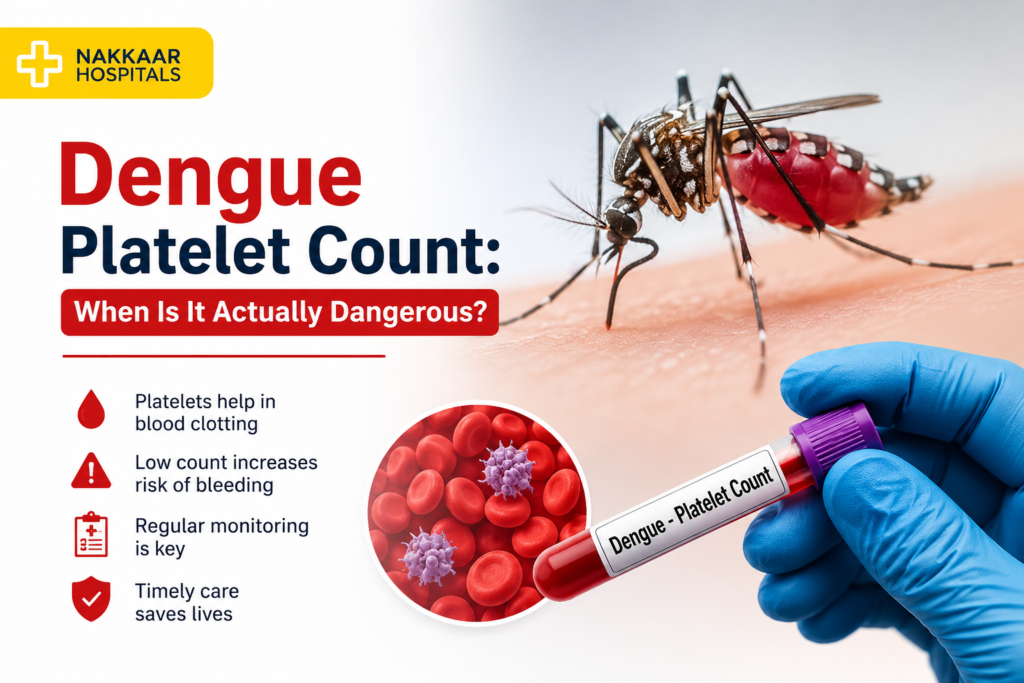
If someone in your house has just tested positive for dengue, you already know what happens next. The dengue platelet count becomes the only number anyone talks about. It gets checked every few hours, texted around the family group, and treated like a countdown to something terrible. And if you’re searching for dengue fever treatment in Mumbai right now because of it, you’re probably not in the mood for vague reassurance, you want to know what the number actually means.
Here’s what usually doesn’t get explained properly: a low platelet count dengue patients experience is not unusual. It happens in almost every case, mild or severe. What actually decides whether someone needs to be admitted isn’t the number sitting alone on a lab report, it’s that number combined with a handful of specific warning signs. Miss that distinction and you either panic over nothing or, worse, underreact when it actually matters.
This piece walks through what the platelet count is really telling you, where the real dengue platelet count danger level begins, when a transfusion genuinely makes sense, and where the papaya leaf juice advice going around your family group falls apart. The idea is to help you read the report without losing your head over it.
What Platelets Are Actually Doing in Your Blood
Platelets are tiny cells made in the bone marrow. Their whole job is to clump together at the site of an injury and stop bleeding. In a healthy adult, the platelet count normal range sits somewhere between 1.5 lakh and 4.5 lakh per microliter of blood.
Dengue attacks this from two directions at once. The virus slows down bone marrow production, and at the same time the immune system starts destroying platelets that are already in circulation. That’s why counts fall so quickly once the fever sets in, and it’s also why, alongside other dengue fever symptoms like body ache and headache, this particular number gets so much attention.
How Platelets Usually Move Through the Illness
Most people are shown scary numbers without ever being told there’s a pattern to how this unfolds. Once you see the shape of it, a lot of the fear goes away.
Days 1 to 3, the fever phase, the count is usually still near normal or only slightly down. This is when the classic dengue fever symptoms, high fever, joint pain, headache, are at their worst, even though the blood report might still look fine.
Days 4 to 6 are the critical phase, and this is where the count typically bottoms out. Doctors call this the nadir. It’s also the window when plasma leakage and warning signs tend to show up, if they’re going to show up at all.
From day 7 onward, most patients start seeing the count climb back on its own, sometimes faster than families expect. That climb is the real beginning of dengue recovery, and it usually happens without any special intervention.
So if the report comes back low on day 5, that’s expected, not a red flag by itself. What actually matters is everything happening alongside it.
Platelet Count Chart: Normal, Low, and the Real Danger Zones
Here’s a rough platelet count chart doctors work off of, though the exact cutoffs shift slightly from hospital to hospital.
| Platelet Count | What It Usually Means |
| 1.5 lakh to 4.5 lakh/µL | Normal |
| 1 lakh to 1.5 lakh/µL | Mild drop, monitoring is usually enough |
| 50,000 to 1 lakh/µL | Moderate drop, most dengue patients land here during the critical phase, regular dengue blood test repeats advised |
| 20,000 to 50,000/µL | Higher risk, hospital observation often recommended depending on symptoms |
| Below 20,000/µL | Critical, meaningful bleeding risk, needs immediate attention |
But numbers on a table only tell half the story. A stable patient at 40,000 with no bleeding and good hydration might just need daily blood tests at home. Another patient at the exact same count, but with a nosebleed or sharp stomach pain, needs dengue hospitalization without delay. Same number, completely different situation.
So When Does It Actually Become Dangerous?
Here’s the part families almost never hear clearly enough. Doctors don’t treat purely on the basis of one report. They watch the platelet count alongside the WHO dengue warning signs, and if any of these turn up, the count on the report stops being the deciding factor:
- Persistent vomiting
- Severe or worsening abdominal pain
- Dengue bleeding symptoms, gums, nose, blood in urine or stool
- Unexplained bruising or tiny red spots on the skin
- Breathlessness or fast breathing
- Cold, clammy skin, or restlessness
- Unusual drowsiness or lethargy
- A platelet count that’s falling fast while hematocrit is climbing
A count below 20,000/µL is broadly treated as when platelet count is dangerous, since spontaneous bleeding risk goes up noticeably past that point. But even below this, plenty of patients who are stable, well hydrated, and free of the warning signs above end up just being watched closely rather than treated aggressively. The number by itself rarely settles the question. It’s the number, the symptoms, and the trend together.
When Is a Platelet Transfusion Actually Necessary?
This is where most of the confusion lives, so let’s be blunt about it: a low count on its own does not automatically mean platelet transfusion dengue care.
Giving platelets as a precaution, when there’s no bleeding, is actually something the World Health Organization advises against. There’s research showing that unnecessary preventive transfusions can slow down the body’s own platelet recovery and stretch out the hospital stay, all without lowering bleeding risk.
Transfusion generally comes into the picture when the count drops to roughly 10,000 to 20,000/µL with no bleeding and very high risk, or when the count is low and there’s active, visible bleeding, or when bleeding is severe regardless of what the number says.
Beyond these specific situations, standard dengue treatment is supportive: IV fluids for hydration, close tracking of the platelet trend and hematocrit level, and repeat blood tests roughly every day or two. Most patients get through dengue without ever needing a transfusion. The count comes back up on its own once the critical phase passes.
The Papaya Leaf Juice Question, Answered Honestly
At some point during dengue, someone in the family will bring up papaya leaf juice. Let’s deal with the papaya leaf juice dengue myth properly instead of shutting it down or oversell it.
There is a small pilot study that looked at papaya leaf extract in adult dengue patients with low platelet counts, and it did show some promise. But it was a small study, not the kind of large-scale evidence that changes medical guidelines. It’s not something to lean on instead of proper monitoring, and it’s definitely not a reason to delay a hospital visit.
The same logic applies to kiwi, pomegranate, coconut water, goat’s milk, and the rest of the list that circulates every dengue season. These can support a healthy diet, and staying hydrated genuinely does help recovery. But none of it reverses a dangerous platelet drop on its own. If warning signs show up, no juice fixes that. A doctor does.
Myths vs Facts, Quickly
Myth: any drop in count is an emergency. Fact: a mild to moderate drop is normal in almost every dengue case and often resolves with nothing more than monitoring.
Myth: low platelets always mean a transfusion. Fact: most patients never need one. Transfusion is reserved for active bleeding or specific high-risk situations.
Myth: papaya leaf juice quickly fixes a low count. Fact: early research suggests it might help, but it’s not a substitute for medical monitoring.
Myth: a rising count means you’re out of danger. Fact: recovery still needs a doctor’s confirmation, since hydration and other factors matter too.
Myth: the exact number is all that matters. Fact: doctors look at the number, the rate of decline, hydration, and symptoms together.
Dengue Fever Recovery Time: What’s Normal
Once a patient clears the critical phase, usually around day 6 or 7, the count generally starts climbing on its own, and it often surprises people how quickly it happens. Fever settles, appetite comes back, energy returns gradually over the next week or two. That’s the typical dengue fever recovery time, though it varies with age and general health. Most doctors will want a follow-up blood test before clearing you for anything physically demanding, just to confirm the count is genuinely back in a safe range.
When to Stop Waiting and Go to the Hospital
Don’t wait for the next scheduled test if any of these show up:
- Sudden, severe abdominal pain
- Repeated vomiting
- Any visible bleeding, even something that seems minor
- Trouble breathing
- Extreme fatigue, confusion, or unusual drowsiness
- A platelet count falling sharply between two tests taken close together
In moments like these, getting evaluated quickly matters far more than trying to work out what the number means on your own.
The Bottom Line
A falling platelet count during dengue is one of the most predictable parts of the illness, not proof that something has gone wrong. What actually decides how worried to be is the combination of the number, how fast it’s moving, and whether warning signs are present alongside it. Understanding that difference is what lets a family respond calmly and correctly instead of panicking at every blood report.
If platelet counts are dropping in your household right now, don’t try to manage it on home remedies and guesswork. Get it looked at by a doctor who can weigh the full picture, not just one number.
Looking for a Dengue Doctor in Bhandup or Mulund?
If someone in the Bhandup or Mulund area is showing dengue symptoms or a falling platelet count, it’s not something to sit on. Navkaar Hospitals, on LBS Marg, Bhandup (W), is an NABH-accredited multi-specialty hospital with round-the-clock emergency care, an in-house 24/7 pathology lab for same-day dengue blood test results, and experienced General Medicine and Critical Care teams who manage dengue at every stage, from routine monitoring right through to intensive care if it’s ever needed.
You can check our full range of health checkup packages if you’d like a broader blood workup done alongside dengue testing, or browse our doctors if you’d like to consult a specific physician.
Whether you’re searching for a reliable dengue doctor in Bhandup, a well-equipped dengue hospital in Mulund, or dependable dengue fever treatment in Mumbai, our team is available around the clock. You can book an appointment online or simply walk in.