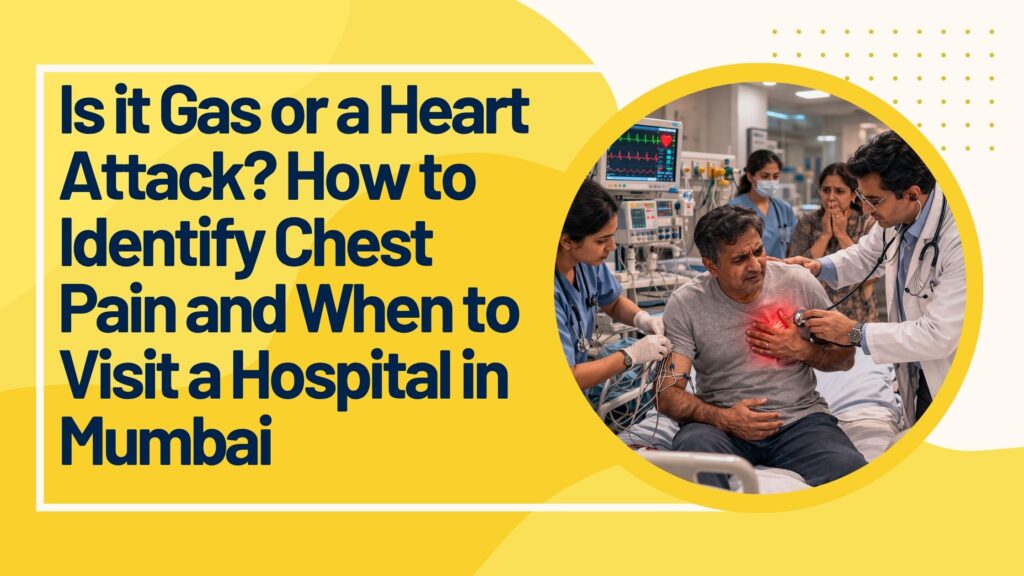
You feel a tightness in your chest after a heavy meal. Maybe it is the biryani. Maybe it is the stress from a long commute across Mumbai. Or maybe, just maybe, it is something your heart is trying to tell you.
Most people in Mumbai dismiss chest pain as gas or acidity. That is understandable. Acidity is extremely common, especially with the eating habits and pace of life this city demands. But here is the problem: some of the deadliest heart attacks get ignored for hours because the person assumed it was just a stomach issue. By the time they reach a hospital, precious time has already been lost.
Whether you are in Bhandup, Andheri, Dadar, or anywhere across Mumbai, knowing the difference between a cardiac emergency and a digestive problem can save your life. And having access to the best cardiologist in Mumbai, available round the clock, makes all the difference in that critical window.
This guide will help you understand the difference between gas pain and heart attack symptoms, what left side chest pain really means, how to find the right chest pain specialist in Mumbai, and when you need to stop waiting and get to a 24/7 cardiac emergency hospital right away.
Why Chest Pain Is Never “Just” Chest Pain
Chest pain has many causes, and not all of them are dangerous. But the tricky part is that your body does not always make it obvious. Heart attack symptoms in women, for example, are often different from the “classic” crushing chest pain most people imagine. Many patients describe their heart attack as a mild discomfort they kept brushing off for hours, sometimes even days.
Chest pain can originate from the heart, the lungs, the esophagus, the stomach, the ribs, or even the skin. That is how complex this symptom is. A pinched nerve in your upper back can cause chest pain. Shingles can cause chest pain before a rash even appears. Anxiety can produce chest tightness so severe it feels like a heart attack.
So what are the main causes of chest pain you should know about?
Cardiac causes: Heart attack (myocardial infarction), angina, pericarditis, aortic dissection, heart failure
Non-cardiac causes: Acidity and GERD, gas and bloating, muscle strain, anxiety and panic attacks, lung issues like pneumonia or pleuritis, costochondritis, esophageal spasm
The challenge is not knowing all these conditions. The challenge is figuring out which one is happening to you, right now, without a doctor’s degree. That is exactly why consulting the best cardiologist in Mumbai at the earliest sign of recurring chest pain is always the right call.
Understanding How the Heart Works and Why Blockages Happen
Before diving into symptoms, it helps to understand what actually happens during a heart attack.
Your heart is a muscle. Like every muscle in your body, it needs a constant supply of blood to keep working. This blood is delivered through three main coronary arteries that run along the surface of the heart. Over time, fatty deposits called plaques can build up inside these arteries. This process is called atherosclerosis, and it happens silently over many years.
When a plaque breaks open suddenly, the body responds by forming a clot at that spot. If the clot blocks the artery completely, blood supply to a section of the heart muscle is cut off. That section starts to die. This is a heart attack.
The damage from a heart attack is permanent if the artery is not opened quickly. That is why the first 90 minutes after symptoms begin are so critical. Every 10 minutes of delay means more heart muscle is lost.
Angina, on the other hand, happens when the artery is partially blocked. Blood flow is restricted but not completely cut off. Angina causes chest pain during exertion that goes away with rest. It is the heart’s way of warning you that a full blockage could happen if nothing is done.
Gas Pain vs Heart Attack Symptoms: The Key Differences
This is the question that brings most people to search engines at 2 AM. Let us break it down clearly.
Signs That Point to Gas or Acidity
- Pain that moves around or shifts when you change position
- Burning sensation in the chest or throat, worse after eating
- Relief after burping or passing gas
- Bloating and a feeling of fullness in the stomach
- Pain that goes away after antacids like Gelusil or Eno
- No sweating, no breathlessness, no arm pain
- Symptoms that started right after a large, oily, or spicy meal
- Sour or bitter taste in the mouth
Signs That Point to a Heart Attack
- Pressure, squeezing, or heaviness in the center or left side of the chest
- Pain that radiates to the left arm, shoulder, jaw, or back
- Sudden shortness of breath even without physical exertion
- Cold sweats, nausea, or vomiting alongside chest discomfort
- A feeling of dread or anxiety you cannot explain
- Dizziness or lightheadedness
- Symptoms that do not improve with antacids or rest
- Unusual fatigue that started days before the chest pain
- Pain that comes on during physical activity and disappears with rest
One important thing to remember: heart attack symptoms do not always feel dramatic. Some patients describe it as “something sitting on my chest” or “I felt uneasy.” Others feel pain only in the jaw or upper back with no chest pain at all. This is especially common in diabetic patients and women.
The Antacid Test: Does It Work?
Many people take an antacid at home and use their response to it as a self-diagnosis tool. If the pain goes away, they assume it was gas. If it does not, they worry about the heart. This test is not reliable. Some heart attack patients feel partial relief from antacids because the esophagus and the heart share nearby nerve pathways. Do not use the antacid response as your deciding factor.
Left Side Chest Pain: What It Usually Means
Left side chest pain is the symptom people fear the most, and for good reason. The heart sits slightly to the left of center, so any cardiac event often shows up on the left side first.
But left side chest pain can also come from:
- Costochondritis (inflammation of cartilage near the ribs)
- Pleuritis (lung membrane inflammation)
- A pulled muscle from heavy lifting or exercise
- Gas trapped in the upper colon (splenic flexure syndrome)
- Anxiety or a panic attack
- Left-sided pneumonia
- A rib fracture from an old injury you may have forgotten
A common pattern in Mumbai hospitals is young men in their 20s and 30s coming in with sharp left side chest pain after a gym session. In most of these cases, it turns out to be a muscle strain or costochondritis. But cardiologists still run an ECG on every one of them, because the cost of missing a cardiac event is too high.
The safest approach is this: if the left side chest pain is new, severe, or comes with any of the heart attack warning signs listed above, do not wait. Go to a cardiac emergency hospital immediately. A chest pain specialist in Mumbai can assess you quickly and rule out anything life-threatening within the first 30 minutes of arrival.
Heart Attack Symptoms in Women: Why They Are Often Missed
Women’s heart attack symptoms deserve their own section because they are genuinely different from what most people expect, and they get missed far too often.
While men typically experience the classic crushing chest pain and left arm radiation, women are more likely to report:
- Unusual fatigue for days or weeks before the event
- Nausea or indigestion that does not respond to antacids
- Shortness of breath without any chest pain
- Pain in the upper back, between the shoulder blades
- Jaw pain or neck pain
- Dizziness and lightheadedness
- Feeling of anxiety or a sense that something is wrong
Many women dismiss these symptoms as stress, hormonal changes, or simply being tired from managing work and home. Doctors sometimes underestimate them too. This is why heart disease remains one of the leading causes of death in Indian women, even though it is less talked about than it is in men.
If you are a woman experiencing any combination of the symptoms above, especially if you are above 45 or have gone through menopause, please get checked. Do not wait for the “classic” chest pain to appear.
The Symptoms You Should Never Ignore
Regardless of what you think is causing your chest pain, these are the red flag symptoms that require emergency care:
- Chest pain lasting more than 5 minutes without relief
- Pain spreading to the left arm, jaw, neck, or back
- Breathlessness at rest or with minimal activity
- Sudden sweating with cold and clammy skin
- Irregular or fast heartbeat (palpitations)
- Fainting or near fainting
- Nausea or vomiting with chest discomfort
- Chest pain in anyone with known diabetes, high blood pressure, or a family history of heart disease
- Chest pain that woke you up from sleep
- Recurring chest pain that comes and goes over several days
If you experience any of these, call for help immediately. Do not drive yourself to the hospital. Do not wait to see if it gets better on its own.
Silent Heart Attacks: When There Is No Pain at All
This is something most people do not know. Roughly 1 in 5 heart attacks is silent. There is no dramatic chest pain, no radiating arm pain, no sweating. The person feels nothing, or something so mild they never suspect the heart.
Silent heart attacks are more common in:
- People with diabetes (nerve damage reduces pain sensation)
- Elderly patients
- Women
A silent heart attack is often discovered weeks or months later during a routine ECG or health checkup. By that point, there is already permanent damage to the heart muscle. This is one of the strongest arguments for getting a regular heart checkup, even when you feel completely fine.
When to Go to a 24/7 Cardiac Emergency Hospital in Mumbai
The golden window for treating a heart attack is the first 90 minutes. Doctors call it “door to balloon time,” referring to the time between arriving at the hospital and getting the blocked artery opened. Every minute counts.
Research shows that for every 30-minute delay in treatment, the risk of death increases by about 7.5 percent. Patients who arrive within the first hour of symptoms have significantly better outcomes than those who wait 3 to 4 hours.
If you are in Bhandup, Mulund, or the surrounding areas of Mumbai, Navkaar Hospitals offers 24/7 cardiac emergency care with on-site interventional cardiology services. You do not need an appointment. You do not need a referral. Walk in or call ahead, and the team is ready.
What Happens When You Arrive at the Emergency
A lot of people delay going to the hospital because they are afraid of going through a complicated process or being sent home embarrassed if it turns out to be gas. Here is what actually happens at Navkaar Hospitals when you come in with chest pain:
Step 1: Immediate triage. Chest pain patients are seen on priority. You will not sit waiting for an hour.
Step 2: ECG (Electrocardiogram). This is done within minutes of arrival. An ECG records the electrical activity of your heart and can immediately show if there is a cardiac event happening.
Step 3: Blood tests. Troponin levels in the blood rise when the heart muscle is damaged. These results help confirm or rule out a heart attack. Results are typically available within 60 minutes.
Step 4: 2D Echocardiogram (2D Echo). If further assessment is needed, a 2D Echo test gives a real-time image of your heart’s structure and function. This helps diagnose valve problems, reduced pumping capacity, and other conditions.
Step 5: Treatment or further evaluation. Based on findings, the best cardiologist in Mumbai on duty will decide on medication, angiography, stenting, or other appropriate care. At Navkaar Hospitals, a senior cardiologist is available around the clock, not just during office hours.
Step 6: Monitoring and stabilization. Once the immediate crisis is managed, patients are shifted to the cardiac care unit for monitoring. The team tracks heart rhythm, blood pressure, and oxygen levels continuously until the patient is stable.
ECG and 2D Echo Tests: Why They Matter
If you have had recurring chest pain or are at risk for heart disease, getting a routine ECG and 2D Echo test near you is a smart preventive step.
An ECG can detect:
- Previous heart attacks you may not have noticed
- Arrhythmias (irregular heartbeat)
- Signs of coronary artery disease
- Thickening of the heart walls due to hypertension
- Bundle branch blocks that affect electrical conduction
A 2D Echo can detect:
- Weak heart muscle (low ejection fraction)
- Valve problems like aortic stenosis or mitral regurgitation
- Fluid around the heart (pericardial effusion)
- Structural defects present from birth
- Blood clots inside the heart chambers
What Is a TMT (Treadmill Test)?
A Treadmill Test, also called a stress test, is done to see how your heart performs under physical exertion. You walk on a treadmill at increasing speeds while your ECG is monitored continuously. If your heart’s blood supply is restricted during exercise, the ECG will show changes that point to blockages in the coronary arteries. A TMT is often recommended for people with risk factors who want to know if their arteries are functioning well under stress.
What Is Holter Monitoring?
A Holter monitor is a small device you wear for 24 to 48 hours that continuously records your heart rhythm. It is used when palpitations, dizziness, or unexplained fainting occur intermittently and cannot be captured on a standard ECG during a clinic visit. The device records everything, and the cardiologist reviews the data to identify any dangerous rhythm abnormalities.
At Navkaar Hospitals in Bhandup, ECG, 2D Echo, TMT, and Holter monitoring are all available at affordable rates, with results interpreted by experienced cardiologists the same day.
Heart Checkup Packages in Bhandup: Know Before It Happens
Many heart attacks are preventable. The problem is that most people only think about their heart after something goes wrong.
Navkaar Hospitals offers comprehensive heart checkup packages in Bhandup that include:
- Complete blood count and lipid profile
- Blood sugar and HbA1c (for diabetes screening)
- Kidney and liver function tests
- ECG and 2D Echo
- TMT (Treadmill Test) for high-risk individuals
- Blood pressure and BMI assessment
- Consultation with a senior cardiologist
- Dietary and lifestyle counseling based on your results
These packages are designed for people aged 35 and above, those with a family history of heart disease, smokers, people with diabetes or hypertension, and anyone who has experienced unexplained chest discomfort, fatigue, or breathlessness.
Early detection saves lives. More importantly, it gives you a chance to correct course before a crisis happens.
Common Myths About Chest Pain and Heart Attacks in India
Myth 1: Heart attacks only happen to old people. Reality: Heart disease is increasingly common in Indians in their 30s and 40s. Young professionals in Mumbai with sedentary lifestyles, high stress, and poor diets are at real risk.
Myth 2: If I can breathe normally, it cannot be a heart attack. Reality: Many heart attack patients breathe normally for the first hour. Breathlessness is one symptom, not the only one.
Myth 3: I am fit and I exercise, so my heart is fine. Reality: Some of the most well-known cardiac deaths in India have happened to people who appeared physically fit. Exercise helps, but it does not eliminate all risk, especially if your cholesterol, blood pressure, or blood sugar is uncontrolled.
Myth 4: Women do not get heart attacks. Reality: Heart disease is one of the top causes of death in Indian women. The risk rises sharply after menopause.
Myth 5: If it was a heart attack, I would know. Reality: Silent heart attacks happen all the time. Many people discover them months later during a routine checkup.
Who Is Most at Risk for Heart Disease in Mumbai?
Heart disease rates in urban India have been rising steadily over the past two decades. Mumbai’s lifestyle adds specific risk factors:
- High stress from commuting, long work hours, and financial pressure
- Irregular meal timings and dependence on outside food
- Sedentary jobs with very little physical activity
- High salt and refined carbohydrate intake
- Rising rates of diabetes and obesity among younger adults
- Air pollution, which directly impacts cardiovascular health
- Smoking and tobacco use, including gutka and smokeless tobacco
- Family history of early heart disease, which is common in Indian genetics
Indians are also known to develop heart disease about 10 years earlier than Western populations, often before the age of 50. The combination of genetic predisposition and urban lifestyle makes Mumbai residents particularly vulnerable.
If you are in your 30s or 40s and have never had your heart checked, this is a good time to start. Booking a consultation with the best cardiologist in Mumbai does not have to wait until something goes wrong.
Lifestyle Changes That Protect Your Heart
Visiting a cardiologist is important. So is what you do every day at home. Here are the changes that genuinely make a difference:
Diet: Reduce salt, fried food, and refined sugar. Increase vegetables, whole grains, and omega-3 rich foods like fish and flaxseeds. Avoid trans fats found in packaged snacks and bakery items.
Exercise: Even 30 minutes of brisk walking five days a week significantly reduces cardiac risk. You do not need a gym membership. You need consistency.
Quit smoking: Every cigarette damages the inner lining of arteries. The risk of a heart attack drops measurably within one year of quitting.
Control blood pressure: High blood pressure is called the silent killer because it has no symptoms until something serious happens. Get it checked regularly and take your medication without skipping doses.
Manage blood sugar: Uncontrolled diabetes accelerates artery damage. Work with your doctor to keep your HbA1c below 7 percent if you are diabetic.
Manage stress: Chronic stress raises cortisol and adrenaline, which drive up blood pressure and inflammation. Practices like meditation, proper sleep, and breaks from work are not luxuries. They are heart health strategies.
Acidity or Heart Attack: A Quick Reference Guide
| Feature | Acidity / Gas | Heart Attack |
| Location | Upper abdomen, chest, throat | Center or left chest |
| Nature of pain | Burning, shifting | Pressure, squeezing, heaviness |
| Trigger | After eating, lying down | Can occur at rest or with exertion |
| Spreads to | Throat, mouth (sour taste) | Left arm, jaw, back, shoulder |
| Sweating | Rare | Common |
| Breathlessness | Rare | Very common |
| Relieved by antacids | Yes | No |
| Nausea | Possible | Common |
| Duration | Variable, often eases gradually | Can persist or worsen |
| Response to position change | Often improves | No change |
| Associated fatigue | Rare | Common |
Use this table as a rough guide, not a diagnosis. If you are unsure, treat it as cardiac until proven otherwise.
Why Choose Navkaar Hospitals for Cardiac Care in Mumbai
Navkaar Hospitals in Bhandup is one of the trusted names for cardiac treatment in the eastern suburbs of Mumbai. Patients from Bhandup, Vikhroli, Kanjurmarg, Mulund, and Thane choose Navkaar for:
- 24/7 cardiac emergency services with immediate ECG availability
- Experienced cardiologists with expertise in interventional cardiology
- Advanced diagnostics including ECG, 2D Echo, TMT (Treadmill Test), and Holter monitoring
- Transparent pricing on heart checkup packages with no hidden charges
- Cardiac ICU with continuous monitoring for critical patients
- Angiography and angioplasty services for blocked coronary arteries
- Accessible location with easy connectivity from across Mumbai’s eastern suburbs
Finding the best cardiologist in Mumbai is not just about credentials on a wall. It is about getting the right diagnosis fast, having access to advanced diagnostics without being transferred across three hospitals, and being treated by someone who takes your chest pain seriously even if it turns out to be nothing. Navkaar Hospitals brings together senior interventional cardiologists with years of experience managing acute cardiac cases across Mumbai’s eastern suburbs and beyond.
Final Thoughts: Do Not Guess With Your Heart
Gas pain is uncomfortable. A heart attack is life-threatening. The problem is they sometimes feel the same.
If there is any doubt in your mind, go to the hospital. An ECG takes 5 minutes. A 2D Echo takes 20 minutes. Knowing that your heart is fine gives you peace of mind. And if something is wrong, catching it early is the difference between a full recovery and a tragedy.
Thousands of lives are lost every year in Mumbai simply because people waited too long. They convinced themselves it was gas, stress, or something that would pass. Some of them were right. Some of them were not.
Your heart works every second of every day without asking for anything. Give it the attention it deserves. The best cardiologist in Mumbai is closer than you think.